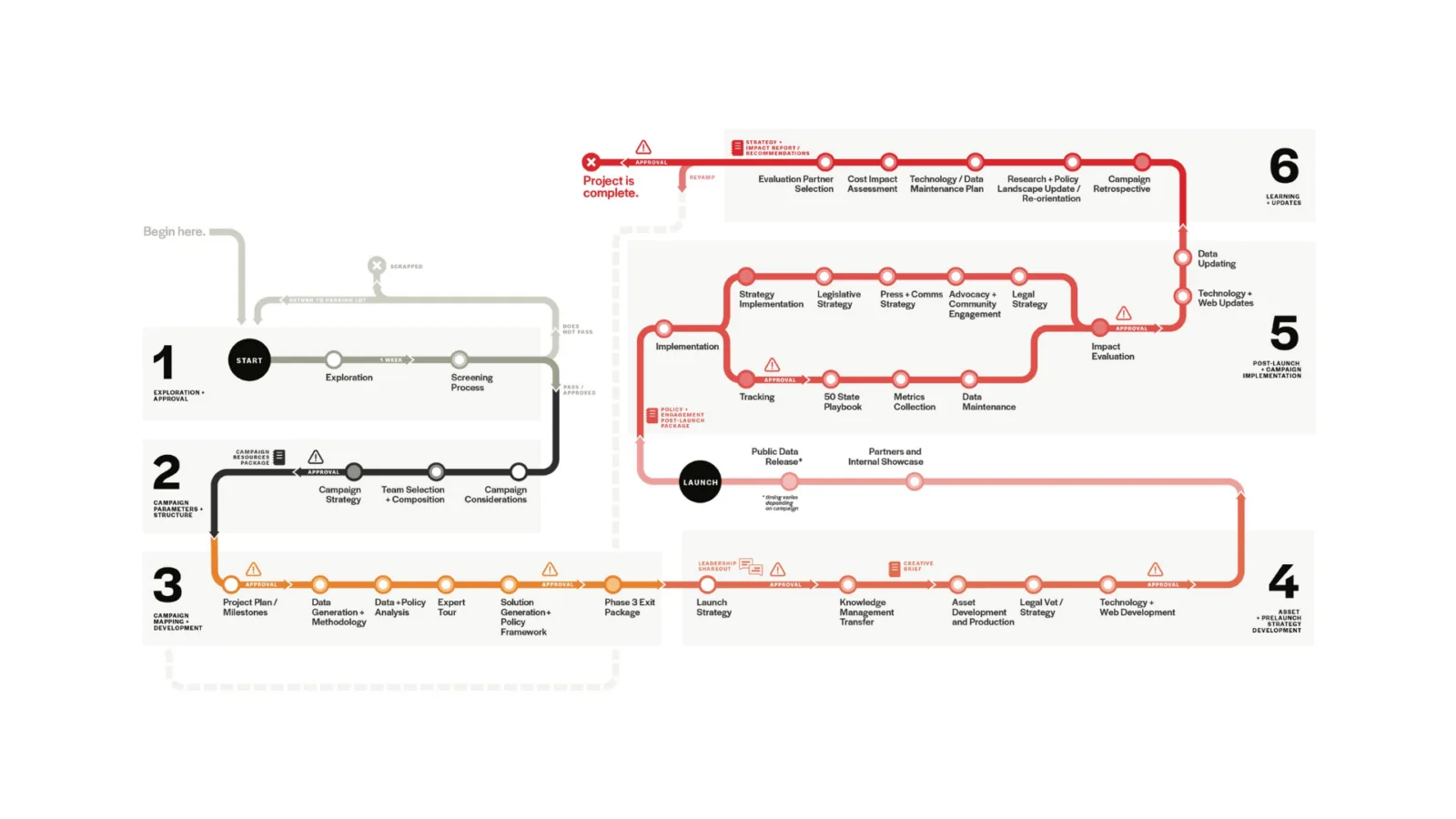
Every campaign you see from Campaign Zero—every website, dataset, and policy demand—is the product of a rigorous process designed to answer one question: will this actually help build a world beyond policing?
In our internal work, we realised that if we were going to actualize our audacious goal of running a large number of campaigns simultaneously across hundreds of cities and states, we’d need clear internal processes and structures to make it possible. Rigor was at the forefront of our mind to ensure that we can stand behind the data to support our policy recommendations.
We tackle campaigns where we see a gap in the space, and we ensure that our solutions are actionable, and backed by rigorous research. Here’s how our process works.
Phase 1: Exploration + Approval. Every campaign starts as a question. Ideas are submitted for consideration, we conduct exploratory research, and a formal campaign proposal goes through our screening process. Plenty of ideas don’t make it past this phase—that’s by design. In fact, we have 130+ ideas on our list that we’ve yet to take on. But if a campaign clears Phase 1, we’re all in: Campaign Zero commits to taking it on.
Phase 2: Campaign Parameters + Structure. Once a campaign is approved, we get the whole organization on the same page about scope—our advocacy, policy, research, technology, and design teams submit considerations that will shape the direction of the work. We select Campaign Leads (a Campaign Manager and a lead from the Research & Data team) who build the campaign strategy from that shared foundation.
Phase 3: Campaign Mapping + Development. This is the core of the work. We build the data and methodology, run the analysis, consult outside experts—we conduct what we call a comprehensive “expert tour”—and translate what we find into concrete policy recommendations. This looks like a 50-state statute analysis and an internal coding process that we have named as “norming.” This process takes a minimum of 3–5 months, and up to a year. We will be publishing how our norming process works soon. By the time a campaign exits Phase 3, we know exactly what we’re asking for and why—and it’s ready to start preparing for public launch.
Phase 4: Asset + Pre-Launch Strategy Development. Research doesn’t change policy on its own—it has to reach people. We develop a full launch plan: asset production and web development, communications and advocacy strategy, and thorough vetting and legal review before anything goes live. We also plan ahead here for how we’ll maintain the data and measure success once the campaign is out in the world.
Phase 5: Post-Launch + Campaign Implementation. Launch day is the beginning, not the end. This is the longest phase: legislative strategy, press and communications, community engagement, public data releases, and state-by-state playbooks. This is happening all while we track metrics and keep the data current.
Phase 6: Learning + Updates. After it’s been out in the world for a while, we evaluate our ongoing campaigns with honesty. What has been the impact of the campaign thus far? Has it meaningfully improved people’s lives? Now that it’s been living in the world for some time, what should we do differently? When is it time to wind a campaign down and why? Those answers feed directly into the next iteration of a campaign, so the work keeps getting sharper and responds to the needs of the time.
Not every campaign follows this workflow exactly; advocacy moves fast, and some campaigns take an amended route. But the underlying commitment never changes: research first, launch with a plan, and stay accountable to its impact long after the announcement. We review our workflow annually to ensure that it’s still working towards its intended goal, and for us internally.
That’s how we make sure every campaign isn’t just making a point—it’s built to win.